
Tea infuser for a mug
The commonest reason a mug infuser gets abandoned in a drawer is that it does not sit properly on the cup its owner actually uses. Fit comes down to one number: the width of your mug's opening.
of American households keep tea in the cupboard
Americans drinking tea on any given day
The measurement that decides whether a tea infuser for a mug fits yours
Take a ruler across the top of the mug you drink from most, inside rim to inside rim. That single number decides whether any mug infuser will work for you, and almost no product page tells you what it needs to be.
Ours needs an opening wider than about 7 cm. The basket is 6.5 cm across its rim and 7 cm deep, and it hangs from the mug edge rather than resting on the bottom, so depth is not a constraint — only width is. A standard American mug runs 8 to 9 cm across; a large latte mug 10 or more; a small teacup 7 to 8. All of those work.
| Cup type | Typical opening | Fits? |
|---|---|---|
| Standard mug | 8 – 9 cm | Yes, comfortably |
| Large latte or soup mug | 10 – 12 cm (4.72 in) | Yes — the long arm spans it |
| Teacup | 7 – 8 cm (3.15 in) | Yes |
| Espresso cup | 5 – 6 cm (2.36 in) | No — narrower than the basket |
| Travel tumbler, narrow neck | 6 – 7 cm | Usually not — see the bottle instead |
If your everyday cup is at the narrow end, the infuser bottle solves the same problem a different way, by building the chamber into the vessel rather than hanging it off a rim.
Why the two handles are different lengths
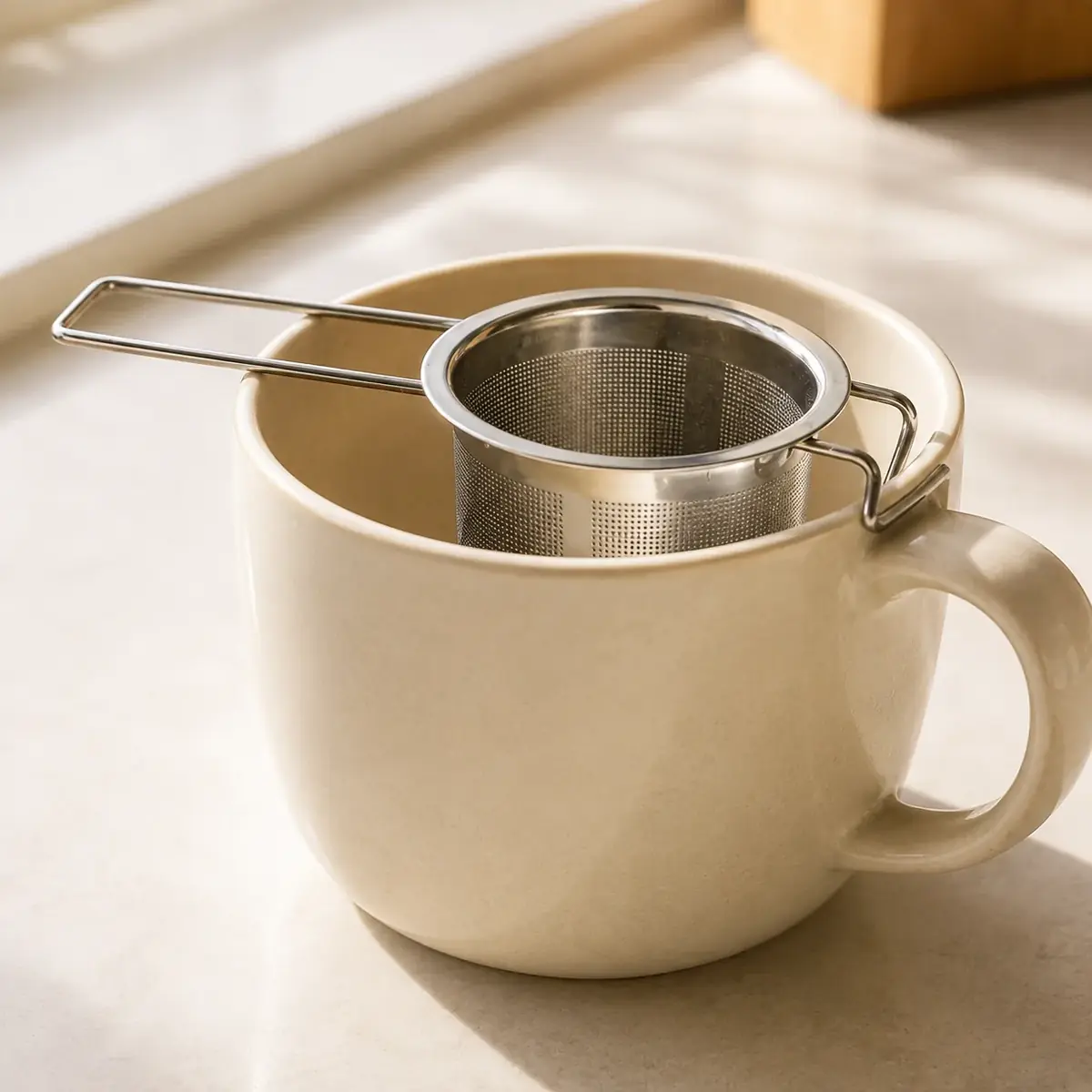
A symmetrical pair of arms only balances on one rim width — too narrow and they slip inwards, too wide and the basket tips. Unequal arms behave differently: the long flat arm, 4 cm, reaches across and takes the load, while the short 1.5 cm hook catches the near edge and stops the basket sliding. Between them they find a stable seat on a range of diameters rather than one.
There is a second benefit that only shows up in use. The long arm sits well away from the water and is thin, so it stays cool enough to lift by even when the mug is full of freshly boiled water. You are not fishing a hot basket out with a spoon.
Brewing with a tea infuser for a mug, in practice
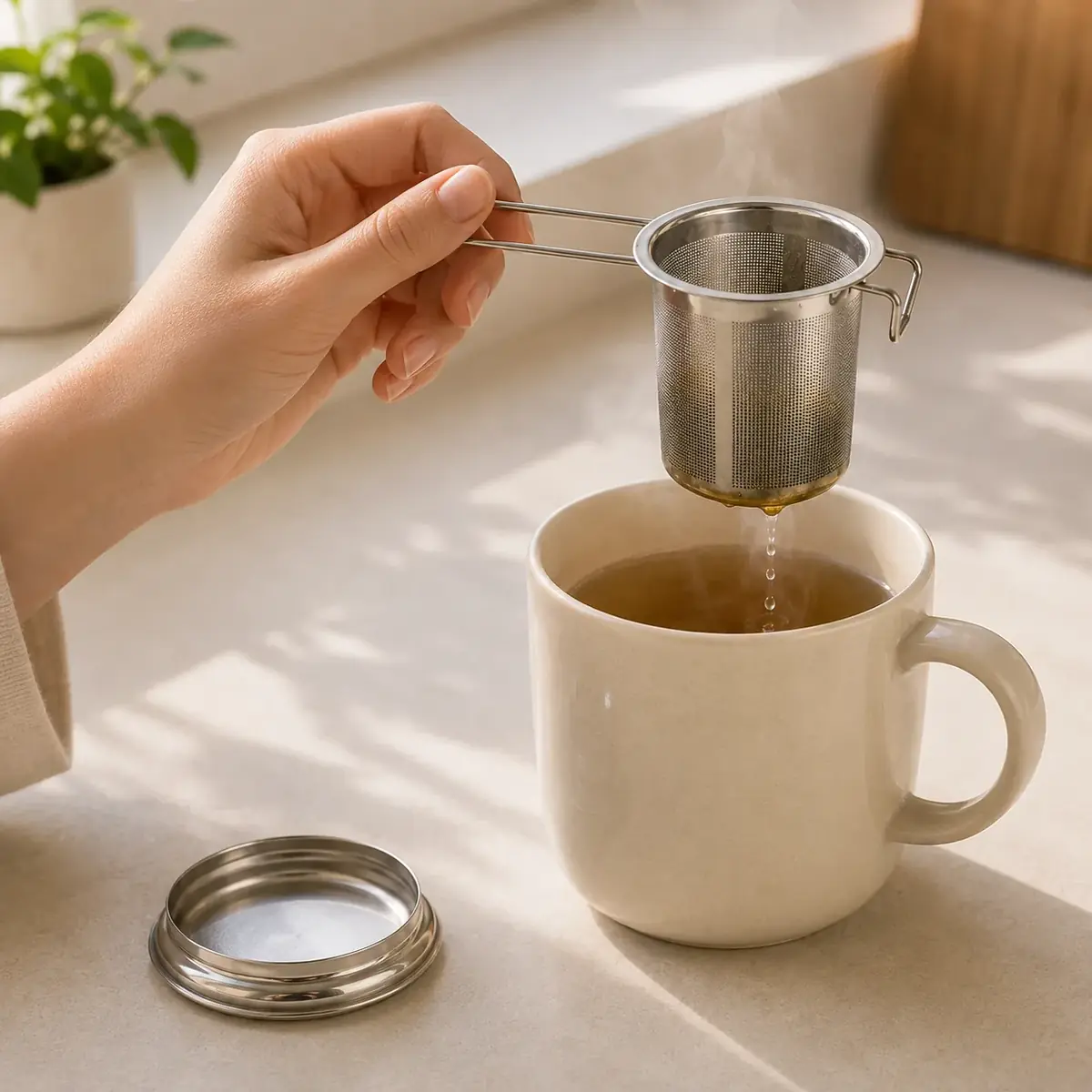
Put the leaf in, hang the basket on the rim, pour water over the leaves rather than beside them, and put the lid on. Covering matters more in a mug than in a pot, because a mug has a wide open surface and loses heat fast — an uncovered mug can drop several degrees in the first minute, and that changes extraction.
When the tea tastes right, lift the basket out and set it on the upturned lid. The dome has a raised rim deep enough to hold the drips, so it works as a small tray on the counter or a desk. That is the whole ritual, and it takes no longer than a tea bag.
Desk tea, specifically
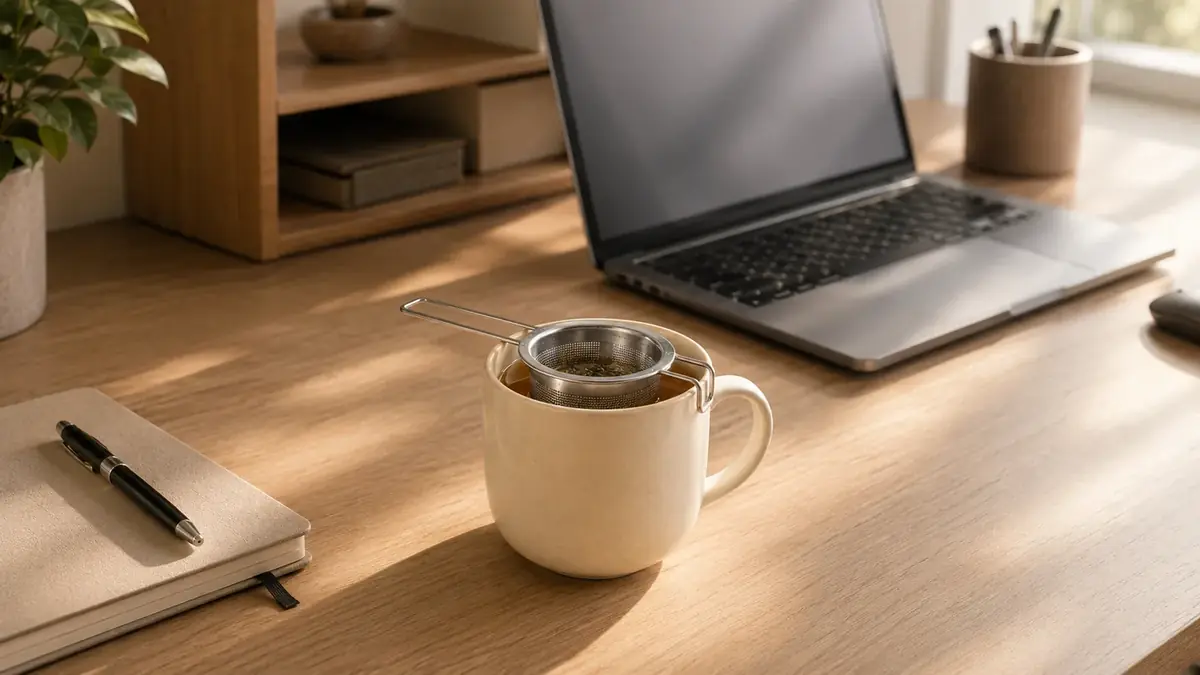
Most mug infusers are bought by people who brew at work, and desks impose their own constraints. There is no sink within reach, so wherever you put the wet basket has to be something you already own — hence the lid. There is often no kettle, only a hot tap or a machine, which means water below boiling and longer steeps for black tea. And there is usually only one mug.
The practical consequence: brew a touch longer than the packet says if your water is not at a full boil, and lift the basket rather than leaving it in while you take a call. Tea left on the leaves for twenty minutes is undrinkable regardless of how good the leaf was.
One basket, two cups
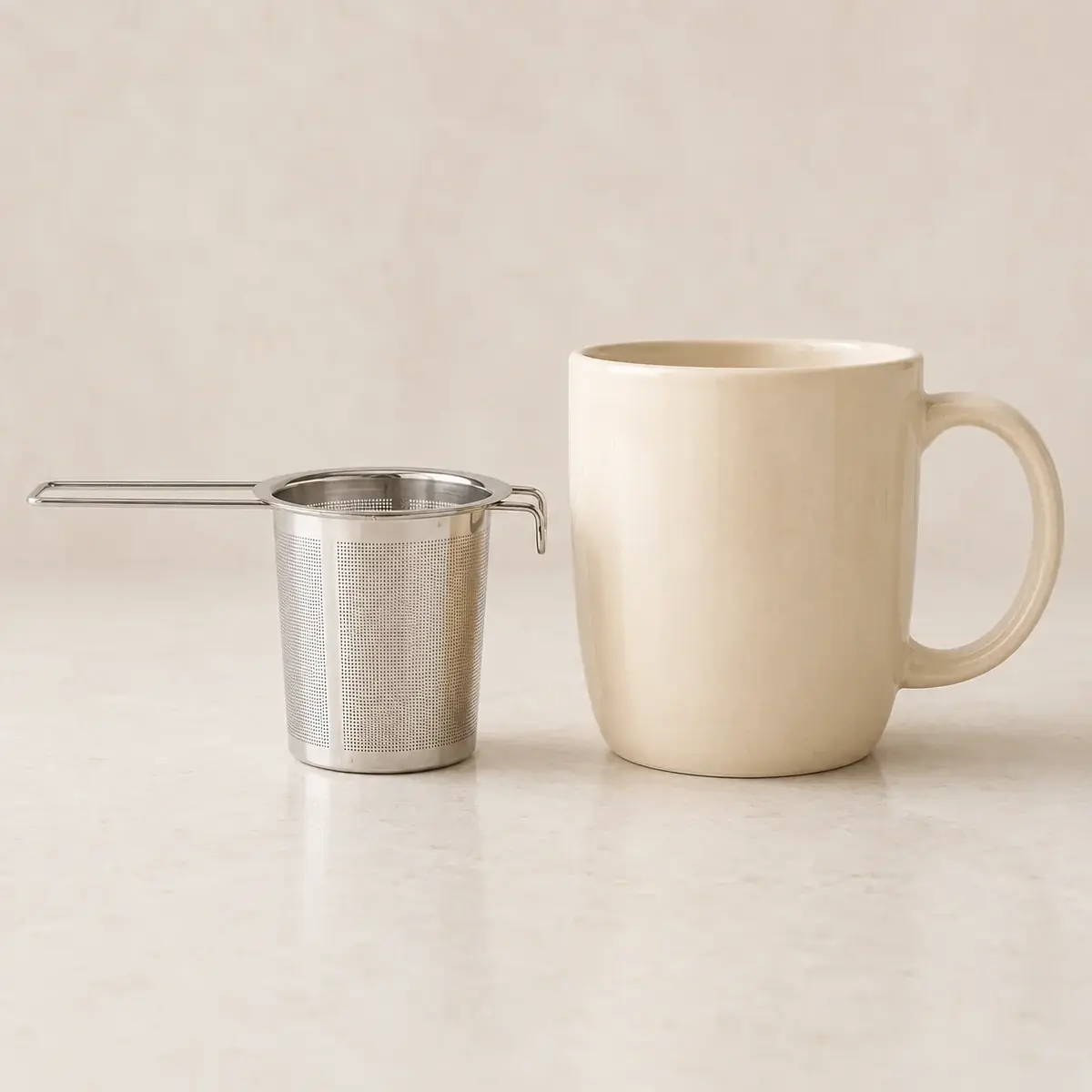
The basket holds enough leaf for more than a single mug, which is worth knowing if two of you drink at the same time. Brew the first at full strength, lift, then return the basket to a second mug and add thirty seconds. On whole-leaf teas the second cup is frequently better than the first because the leaf has fully opened by then. On broken-grade black tea it will be noticeably weaker, so this works best with oolong, white and pu-erh.
Choosing between the three formats
The basket is the format for a cup on a desk or a counter, on a mug wider than about 7 cm. Tea that travels with you is a different job, and the bottle with its sealed upper chamber is built for it — the leaves stay above the drink the whole way, so what you sip on arrival is finished tea.
Brewing for a table rather than a desk is a third job again: the glass teapot pours two to five cups from a single steep, with the leaf contained in a full-height glass insert.
The filtration is the same across all three. What changes is the volume and where you are standing when you drink it.
The lid is doing two jobs
On the mug it holds heat and aroma in while the tea steeps, which matters more on a wide open mug than in a pot. Off the mug, turned over, its raised rim catches what drains from the basket. One object doing two jobs, nothing extra to wash and nothing extra to carry to the sink — which is why it is the detail buyers mention more often than the mesh.
Cleaning at a desk
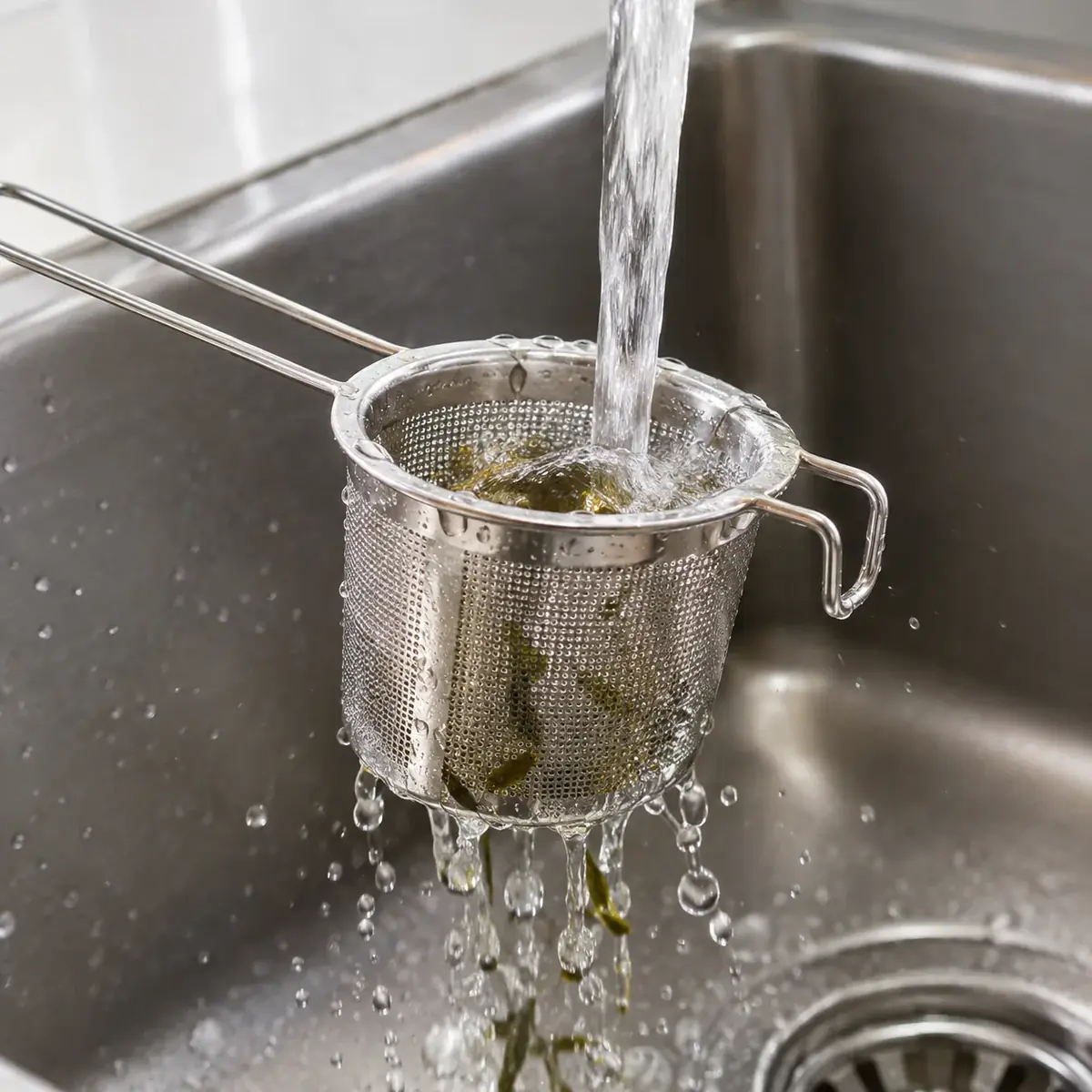
Tap the leaves into a bin while the basket is still warm and they come out in one piece, leaving almost nothing behind. A rinse at the office tap finishes it. The reason to do it immediately rather than at the end of the day is that dried tannin is what eventually stains mesh, and it takes a soak to remove where a rinse would have prevented it. Our step-by-step guide covers the full routine.
Questions about the tea infuser for a mug
What size mug does the infuser fit?
Any mug with an opening wider than about 7 cm (2.76 in), measured inside rim to inside rim. That covers standard mugs at 8 to 9 cm (3.54 in), large latte mugs, and teacups from around 7 cm. It will not fit an espresso cup or a narrow-necked travel flask, because the basket itself is 6.5 cm (2.56 in) across.
Do you leave a tea infuser in the mug while you drink?
No. Lift it out when the tea tastes right, usually two to five minutes depending on the leaf, and set it on the upturned lid. Left in, the leaves keep extracting tannin and the cup turns bitter, which is the single commonest mistake with mug brewing.
Does the infuser sit inside the mug or on the rim?
On the rim. Two unequal handles carry it — a 4 cm (1.57 in) flat arm and a 1.5 cm (0.59 in) hook — so it hangs from the edge rather than resting on the bottom of the cup. That is what lets one basket suit mugs of different widths, and it keeps the lifting handle clear of the hot water.
Can I use the same basket for two mugs?
Yes, and with whole-leaf teas the second cup is often better than the first because the leaf has fully opened. Add about thirty seconds to the second steep. Broken-grade black teas give most of their flavor to the first cup, so the second will be noticeably lighter.