
Tea infuser basket
There are four common shapes of tea infuser and they are not interchangeable. The difference is capacity, and capacity decides how much of your leaf actually brews.
The expansion problem, in numbers
Dry tea is a compressed leaf. Water has to get inside the fold before flavor comes out, and to do that the leaf must physically open. A rolled oolong roughly triples in volume. A whole-leaf white can do more. A broken-grade black expands least, because it was already broken.
Now put that against the formats. A ball infuser holds about a teaspoon of dry leaf and has no headroom, so the moment the leaf swells it presses against itself and against the shell. Water stops circulating and starts channelling around the outside of a solid plug. You get a thin cup and a lot of leaf that never gave anything up — and, because it looks like the tea was weak, most people respond by adding more leaf, which makes the packing worse.
| Format | Dry leaf it holds | Headroom to expand | Suits |
|---|---|---|---|
| Basket | Well over a heaped teaspoon | Generous — 7 cm (2.76 in) deep, tapered | Any grade, including large whole leaf |
| Ball | About a teaspoon | Almost none | Small leaf that expands little |
| Spoon clip | Under a teaspoon | None — it clamps shut | A single small cup, occasionally |
| Paper filter bag | Variable | Good, but disposable | Travel, or as a stopgap |
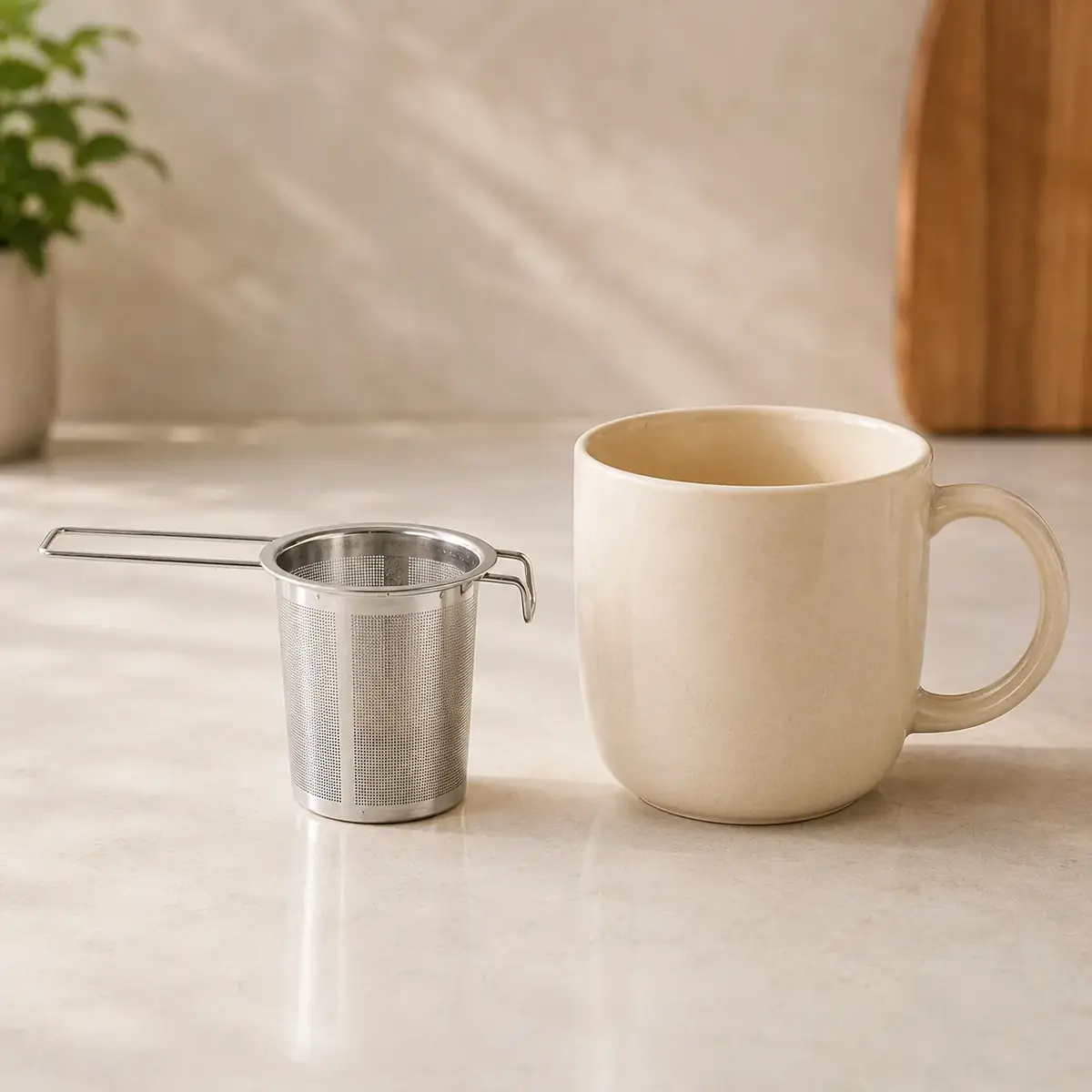
The shape, and why it tapers
The basket is 7 cm deep, 4.8 cm (1.89 in) across the base and 6.5 cm (2.56 in) across the rim. Wider at the top than the bottom is deliberate: as the leaf bed swells upward it moves into more space rather than less, so it loosens instead of jamming. A straight-sided cylinder of the same volume compacts more, and a basket that narrows towards the top would be the worst of all.
Spent leaves also fall out in one piece when you turn it over.
of the North American tea market projected to be loose leaf in 2026
Americans drinking tea on any given day
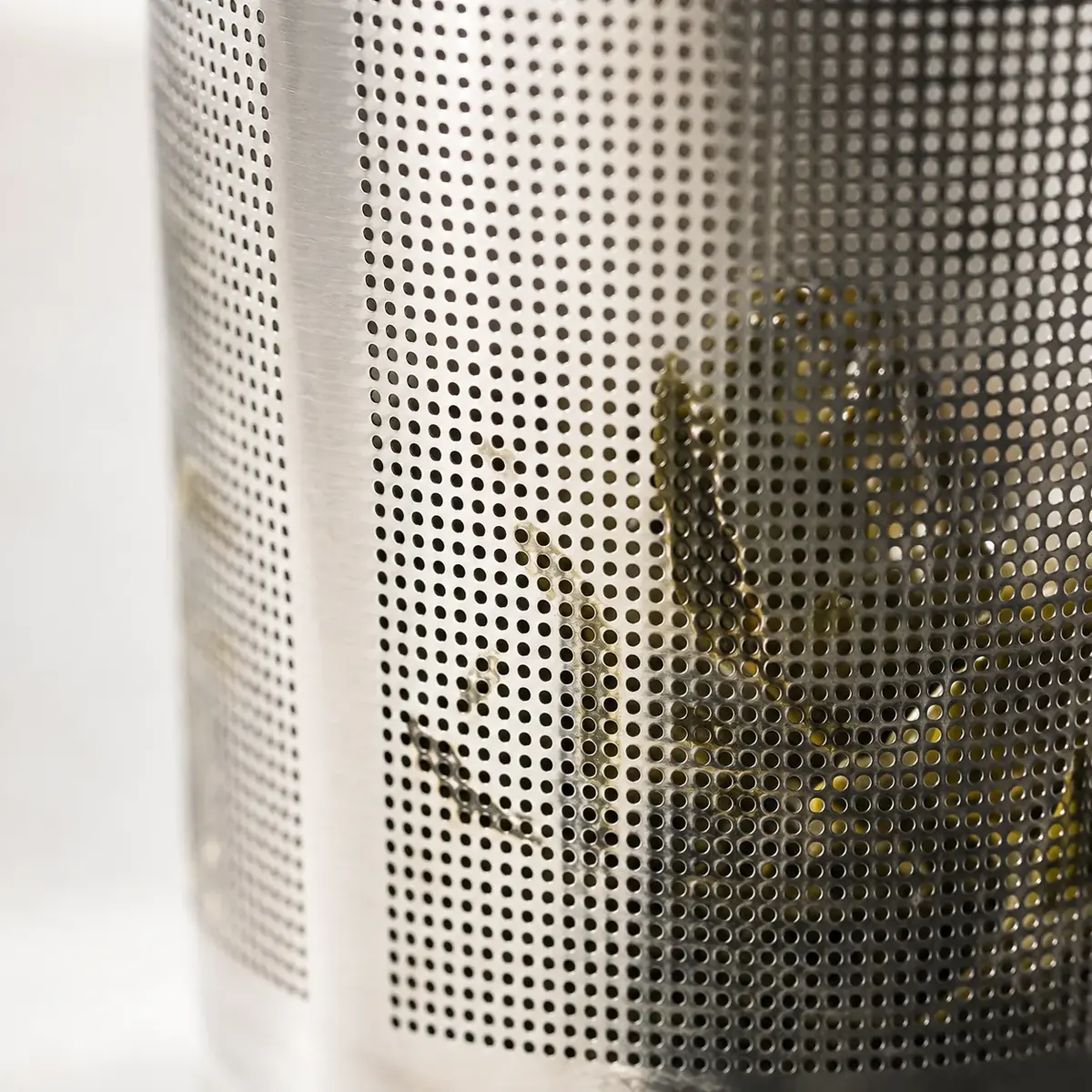
Mesh, and the teas that expose it
Capacity is only half the job. The perforations run over the lower two thirds of the wall — the part in the water — and are fine enough to hold back rooibos needles and the dust in a broken-grade black tea. Those two are what defeat a coarse strainer weave, and they are also two of the most commonly drunk categories in the US.
The upper third is left solid on purpose. Leaves that swell above the waterline stay contained instead of riding over the rim and into the cup, which is what happens with baskets perforated all the way up.
Tea infuser basket versus reusable bag
Cloth and paper reusable bags give the leaf plenty of room and filter well, so they solve the two main problems. What they do not give you is speed or a stop button: you have to fill and close one every time, and fish a soggy bag out with a spoon at the end. A basket takes a scoop, hangs on the rim, and lifts out by a cool handle. Over a year of daily tea that difference is what decides whether a method sticks.
Filling a tea infuser basket: how much is the right amount
A level teaspoon of dry leaf per 8 fl oz cup is the working standard, and it is where to start with anything unfamiliar. Two adjustments are worth knowing. Large twisted leaves — rolled oolongs, whole-leaf whites, some pu-erh — weigh far less for their volume, so a level spoon of them is a smaller dose than a level spoon of a fine black tea; go to a heaped spoon or one and a half. Broken grades and dusty teas run the other way and extract fast, so a slightly short measure and a shorter steep gives a cleaner cup than a full measure pulled early.
The basket takes several times that volume, which is deliberate rather than generous. The dry measure is not the number that matters — the wet one is, and it can be three times larger.
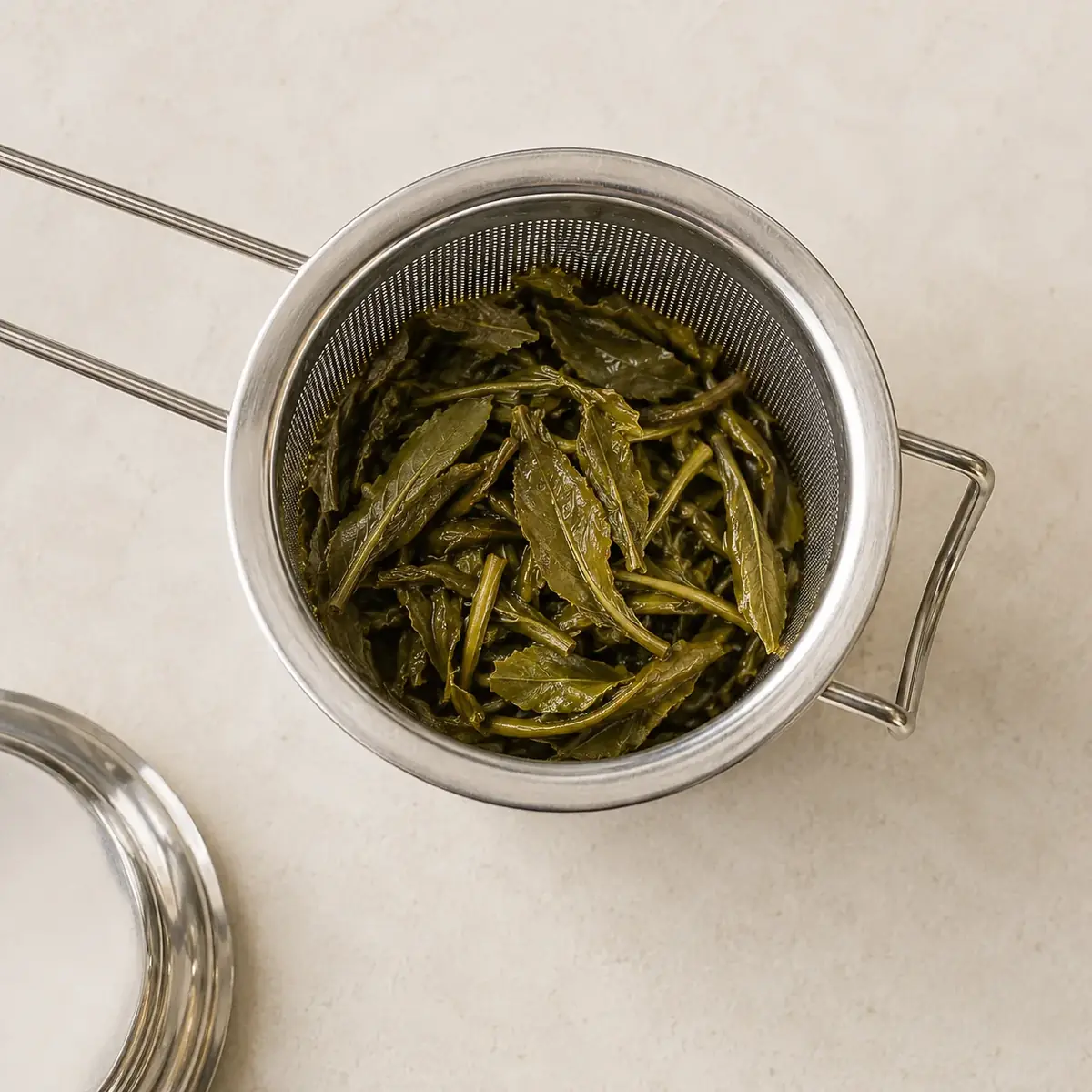
Reading the leaf when it comes out
Turn the spent basket over and look at what falls out, because it tells you what happened. Leaves that have opened flat and gone soft and dark have given what they had. Leaves still curled tight in the middle of the bed did not brew, and that means either the basket was overfilled or the water was too cool. Bits of unopened leaf pressed into a solid disc mean it was packed.
This is the diagnostic that a closed ball infuser hides completely, and it is the fastest way to work out why a tea tasted thin. In a wide basket the evidence is right there every time you empty it.
Which format fits which routine
The basket is built for a cup at a time, which is how most tea gets drunk. Pour for two or more regularly and the glass teapot with a full-height insert covers the table in one steep. Take your tea out of the house and the infuser bottle keeps the leaves sealed above the drink for the whole journey.
All three use the same wide-and-fine principle; they differ in volume and in where you drink. The basket wants a mug wider than about 7 cm — there is a fit table on the mug infuser page if you want to check your cup first.
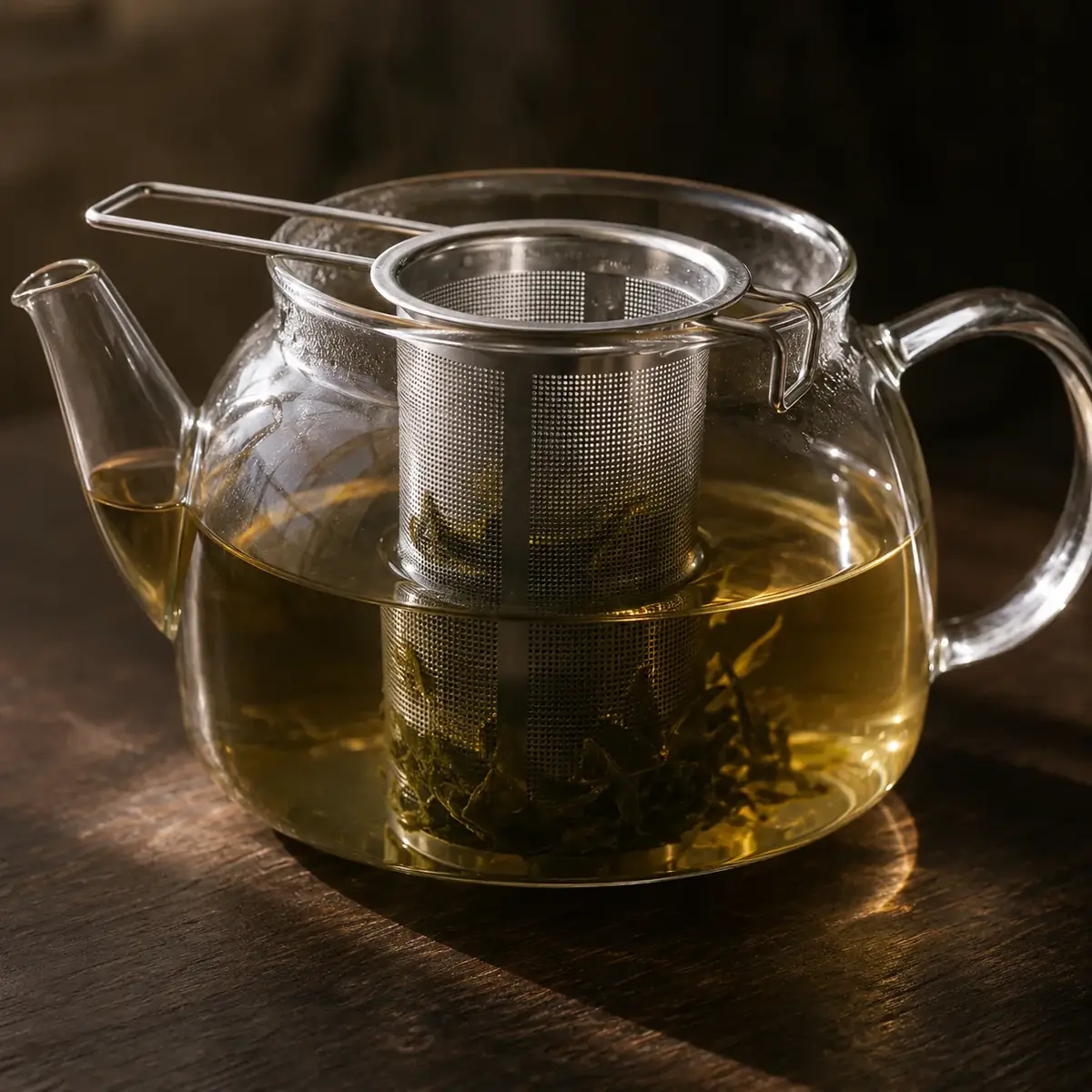
Getting a second steep
The room inside is what makes multiple infusions worth trying. Whole-leaf oolong, white and pu-erh will give a second and often a third cup, and the second is frequently the best, because the leaf has finally opened all the way. Add roughly thirty seconds each time. This is the part of loose leaf that a ball infuser hides from you entirely, and it is the main reason people who switch to a basket say the same tea tastes different.
How much to start with, and how long to leave it, are covered in our guides on leaf quantity and steeping times.
Tea infuser basket questions
What is the best infuser for loose leaf tea?
For most people, a wide fine-mesh basket. It is the only common format with enough room for the leaf to triple in volume as it rehydrates, and fine enough perforation to hold back rooibos and broken grades. Balls and clips are smaller and compress the leaf; bags work but are slower to use.
How much tea does the basket hold?
Well over a heaped teaspoon of dry leaf, with room left over for it to expand. That is the point of the shape rather than a bonus: the standard measure is a level teaspoon per cup, and the basket is built to hold several times that volume once the leaf is wet.
What does a tea infuser actually do for you?
It contains the leaf and gives you a stop button: lift it out and extraction ends, so the cup stays where you put it. That is what makes loose leaf practical every day rather than a weekend ritual. The format decides how well it works — room to expand and fine perforation are the two things to look for.
Can you use a tea infuser basket for coffee?
Buyers do, and say so in their reviews — the fine perforation holds back coarse ground coffee well enough for a cup. It is not a substitute for a proper brewer and very fine grinds will pass through. As an occasional workaround when you have no other equipment, it works.