
Stainless steel tea infuser
Material is not a detail on an object that sits in near-boiling water every day and then gets put away wet. Here is what steel actually changes, and what it does not.
of the North American tea market projected to be loose leaf in 2026
of American households keep tea in the cupboard
Why the material shows up in the cup
An infuser spends its life doing three things: sitting in water at 175 to 212 °F (80 to 100 °C), holding wet organic matter, and drying in a cupboard. Each one is a test of the material.
Odor. Silicone is porous at a microscopic level and takes on the smell of what it holds. Anyone who has brewed a smoky lapsang souchong in a silicone infuser and then made jasmine green in the same one has met this. Steel does not absorb, so the ninth tea tastes like the first.
Heat. Water off the boil is nothing to steel. Food-grade silicone tolerates it too, but plastic infusers can soften and warp, and warping is what turns a snug lid into a loose one.
Hole size. This is the one that matters most and gets discussed least. A molded silicone hole has a practical minimum size — below it, the mold will not release cleanly. Perforated steel has no such floor. That is why a steel basket can hold back rooibos needles and a silicone one usually cannot.
Where steel earns its place
Steel holds its shape, and that is what makes the two handles work year after year: they keep the same spring and the same seat on a mug rim rather than softening. A rigid basket also empties cleanly — tap it and the leaf bed leaves in one piece, because the wall does not flex and grip.
For a kitchen or a desk, where the infuser lives in a drawer and meets boiling water daily, rigidity and fine perforation are the two properties that matter, and steel is the material that delivers both.
The basket itself
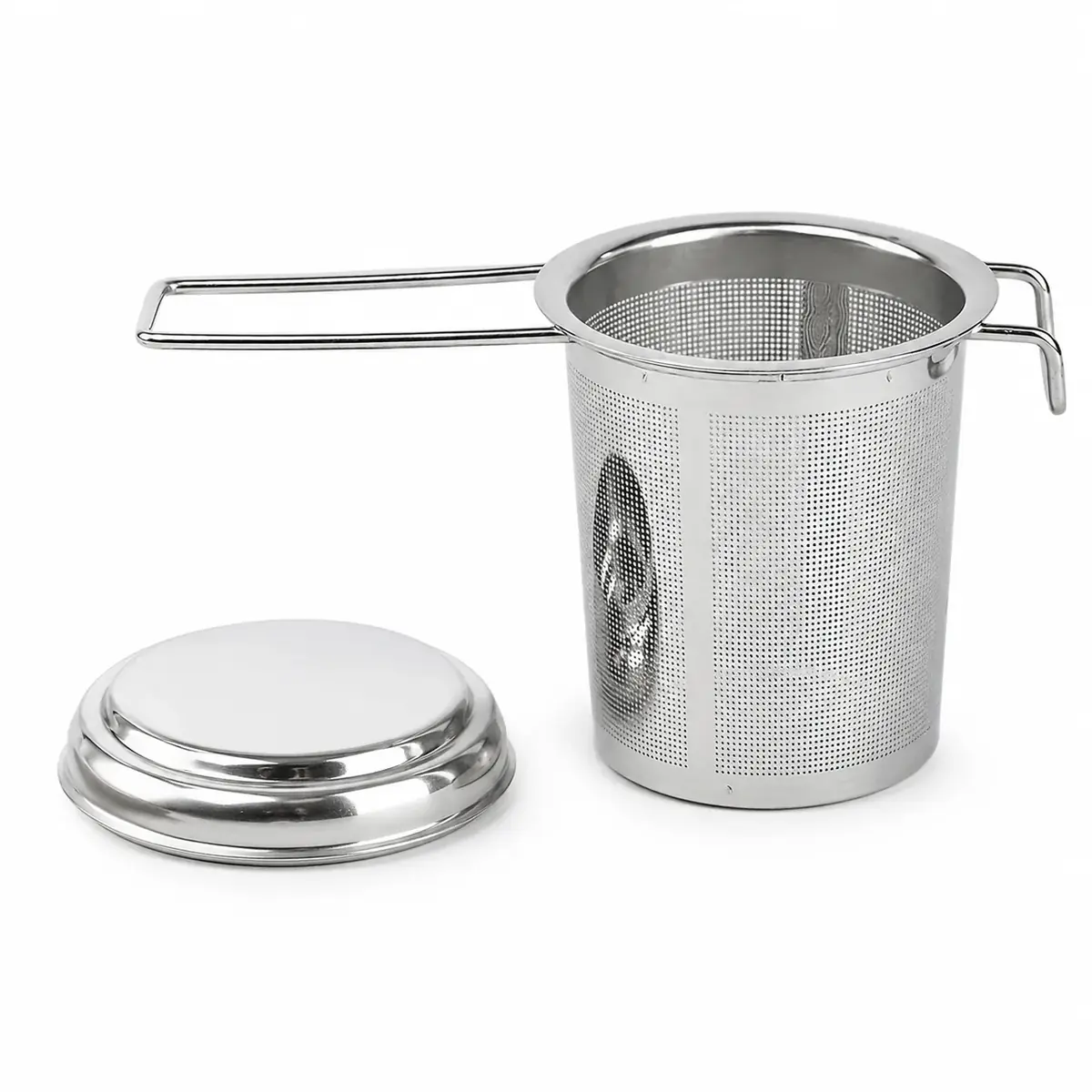
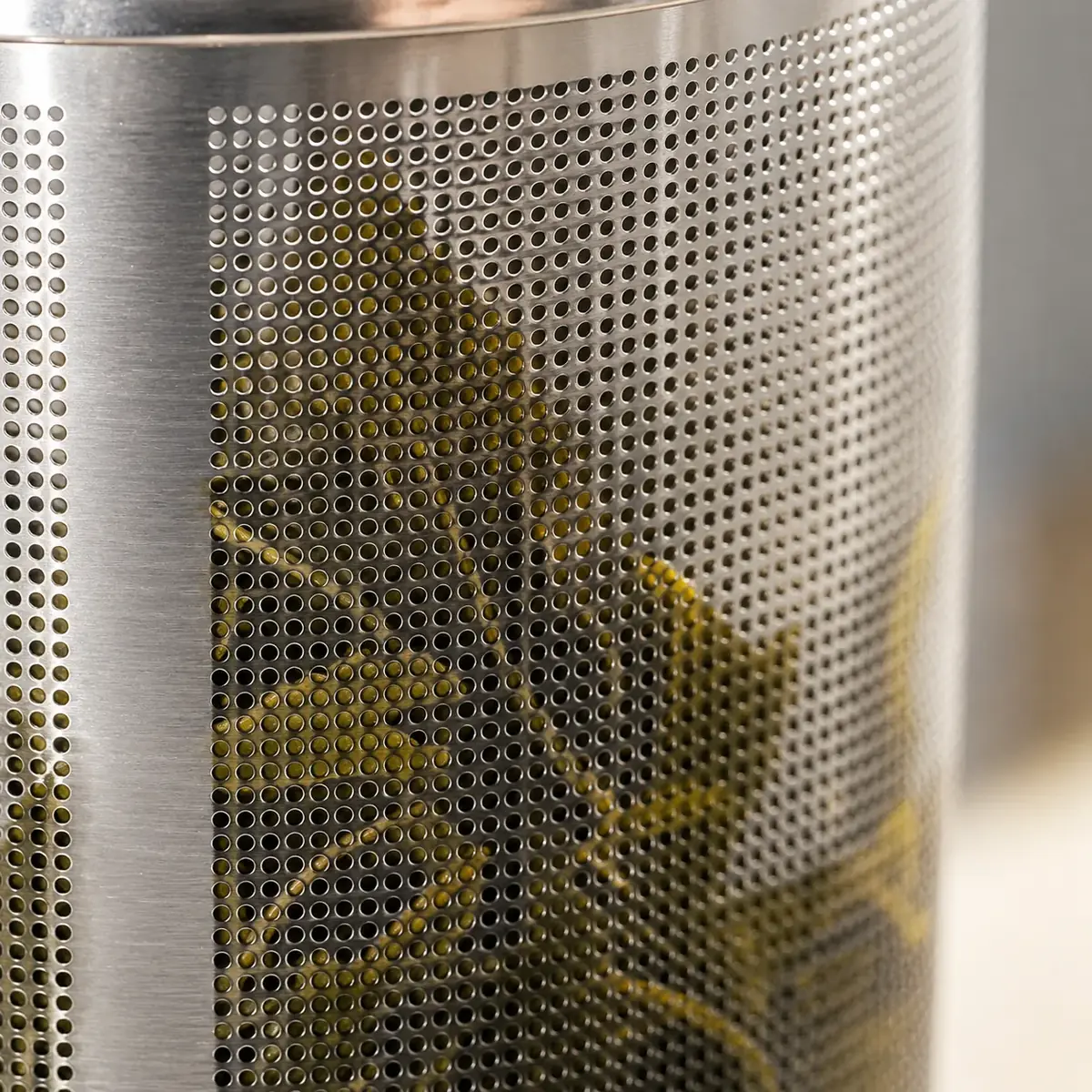
The Teabrim basket is stainless steel throughout — body, mesh, lid and both handles. It measures 7 cm (2.76 in) tall, 4.8 cm (1.89 in) across the base and 6.5 cm (2.56 in) across the rim, and weighs 43 g (1.5 oz). The perforations run over the lower two thirds, the part that sits in the water; the upper wall stays solid so leaves that swell above the waterline stay inside rather than riding over the edge.
| Specification | Figure |
|---|---|
| Height | 7 cm / 2.76 in |
| Base diameter | 4.8 cm / 1.89 in |
| Rim diameter | 6.5 cm / 2.56 in |
| Long handle | 4 cm / 1.57 in flat arm |
| Short handle | 1.5 cm / 0.59 in hook |
| Weight | 43 g |
| Perforated area | Lower two thirds |
The two handles are not a styling choice
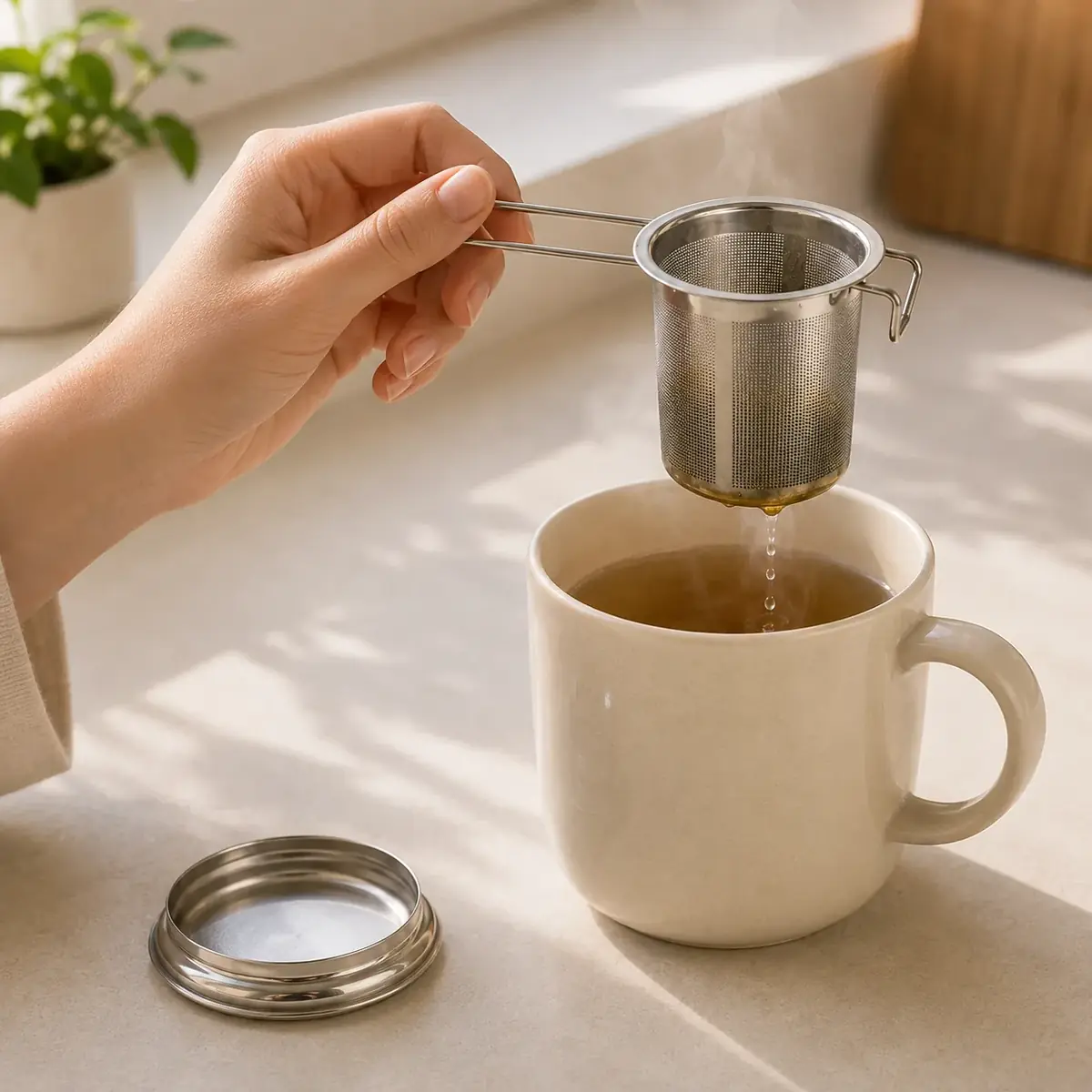
One long flat arm, one short hook, deliberately unequal. A symmetrical pair only balances on a rim of one particular width. An unequal pair finds purchase across a range, which is why the same basket sits on a narrow teacup and a wide breakfast mug without wobbling. The long arm also stays cool enough to lift by, because it is far from the water and thin enough not to carry much heat.
Caring for a stainless steel tea infuser, and what actually damages steel
Very little does. Steel does not rust in ordinary kitchen use, does not stain from tea in the way ceramic can, and does not care about dishwashers. What does mark it over time is tannin dried into the perforations, and that is a habit problem rather than a material one: tap the leaves out warm, rinse, and it stays clean indefinitely. Our guide on how to use a tea infuser covers the routine.
If mesh has gone dull after months of neglect, a soak in hot water with a little citric acid or lemon lifts tannin without scouring. Avoid wire wool — it scratches the polish and gives future residue somewhere to hold on.
Steel in the rest of the range
Grades of stainless, and what the numbers mean
Kitchen steel is usually quoted as 304 or 18/8, which are the same thing described two ways: roughly 18 percent chromium and 8 percent nickel in an iron base. The chromium is what forms the thin passive oxide layer that makes the surface self-repairing — scratch it and the layer reforms in air, which is why stainless resists corrosion rather than merely delaying it.
For an infuser this matters less than it does for a knife or a pan, because the object never meets salt, acid at high heat, or prolonged storage of food. Tea at 203 °F (95 °C) for four minutes is an undemanding job. The practical consequence is that any food-grade stainless will do here, and the difference between a good infuser and a poor one lies in the perforation and the shape rather than in the alloy.
Polish, and why the inside is smooth
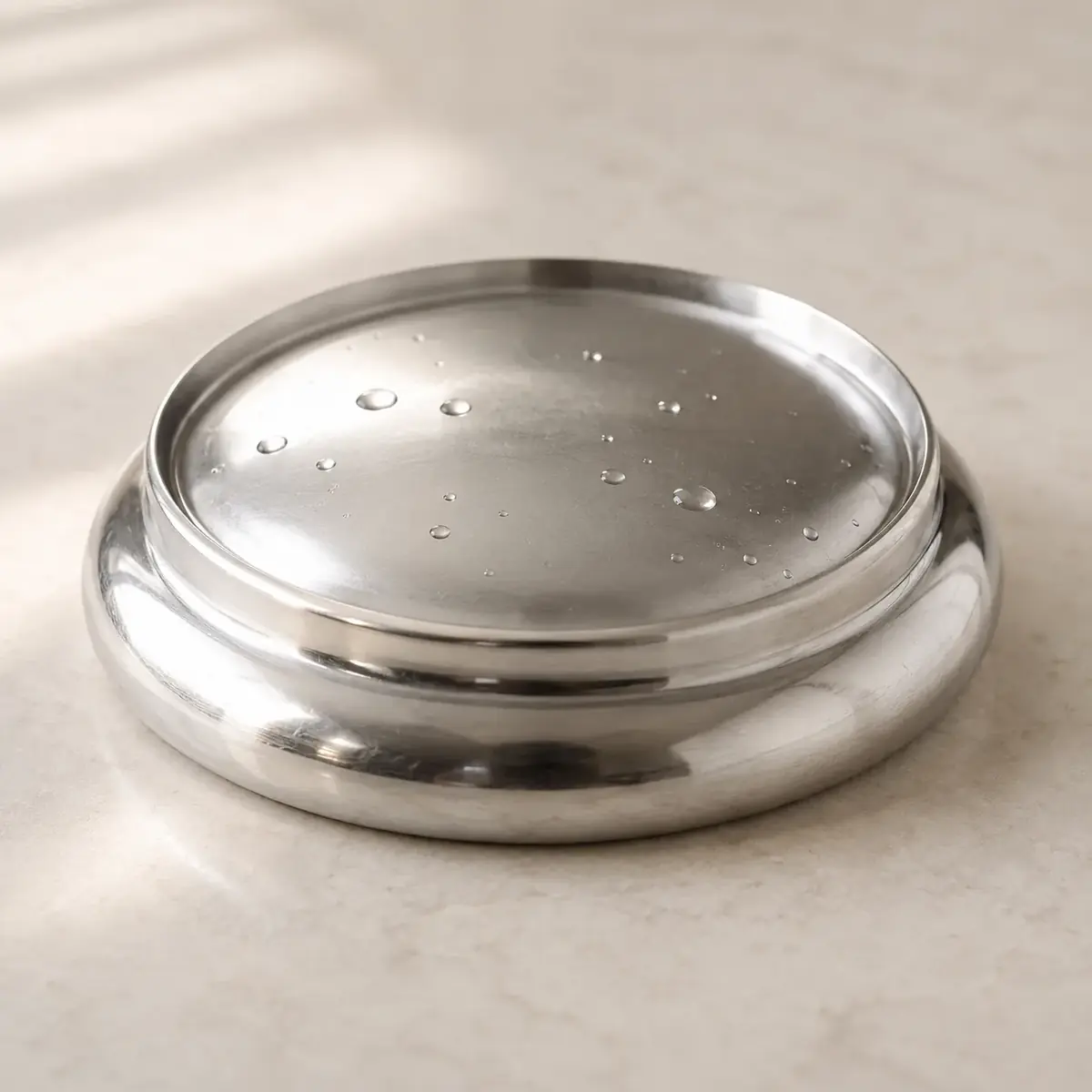
The interior wall is polished rather than left matte, and that is a functional choice as much as a cosmetic one. A smooth surface gives dried tannin nothing to grip, so residue rinses off rather than building into the brown film that dulls neglected mesh. It also means the basket looks the same after a year of daily use as it did on the first day, provided you do not scour it with wire wool.
Weight, and why 43 g is the right amount
Light enough that the two handles can carry it on a mug rim without the whole thing tipping when the basket fills with wet leaf; heavy enough that it does not float or shift when you pour water in. Very thin steel would flex when you tap the leaves out, and flexing is what eventually distorts a mesh wall. The 43 g figure is measured with the lid.
What to expect from a stainless steel tea infuser over a year
Steel that is rinsed after use looks new indefinitely. Steel that is put away wet with leaves still in it develops brown staining in the perforations within a few weeks — not damage, but visible. The recovery is a soak in hot water with citric acid, and then the habit change. Nothing about the material fails; what fails is the routine, and it is a thirty-second routine.
Steel in the rest of the range
The infuser bottle uses a steel collar between its two glass chambers, which is both the seal and the filter. The glass teapot is the one product that is not steel: its insert is borosilicate glass, because the reason to buy a glass pot is to watch the leaves, and a steel insert would hide them. Filtration there comes from slots in the glass rather than mesh.
Choosing between stainless steel tea infuser formats
If you brew one cup at a time, the basket on a mug is the whole answer. If you carry tea, the bottle. If you pour for others, the teapot. The material logic above applies to the first two; the third is a deliberate exception made for visibility.
There is a longer comparison of materials in our guide to silicone versus stainless steel infusers, including the cases where silicone genuinely wins.
Stainless steel tea infuser questions
Is stainless steel safe for brewing tea?
Stainless steel is a standard food-contact material used throughout kitchens and food production. It does not react with tea, does not leach flavor into it, and does not absorb flavor from it. That neutrality is the practical reason it is the default material for infusers rather than anything more exotic.
Will a steel infuser rust?
Not in normal kitchen use. What people sometimes take for rust is dried tannin, which is brown, sits in the perforations, and lifts with hot water and a little citric acid. Drying the basket rather than putting it away wet keeps it looking new, though steel does not require it.
Is silicone or metal tea infuser better?
Steel holds no odor, takes boiling water without concern, and can be perforated far finer than silicone can be molded, which is what keeps rooibos and broken leaf out of the cup. Silicone is softer, squashes into a drawer and survives being dropped. For daily brewing at home, the finer mesh is usually the deciding factor.
Can you put a stainless steel tea infuser in the dishwasher?
Yes. Steel is unaffected by dishwasher cycles. In practice most people find rinsing faster than loading it, because the leaves come out in one piece if you tap the basket while it is still warm and the perforations clear under running water in a few seconds.