
Loose leaf tea infusers built to let the leaves open
Whole leaves need room to unfurl. This basket gives them a full 7 cm of it, holds back the fine stuff, then lifts out onto its own lid so nothing drips on your counter.
Loose leaf needs space, not a squeeze
Dried tea is a folded, twisted, compressed version of a leaf. Hot water has to get inside that fold before flavor, color and aroma come out — and the leaf needs to physically expand to let that happen. A good oolong can triple in volume. A whole-leaf white tea can do more. That expansion is the whole game, and it is where most infusers fail. A pinch-shut ball holds a teaspoon of dry leaf and nothing more; once the leaf swells it presses against itself and the water only ever reaches the outside of the clump. You get a thin, one-note cup and a lot of leaf that never gave anything up. It is not that the tea was weak. It is that most of it never brewed. A basket solves it by being bigger than the leaf needs to be. Seven centimeters deep and nearly five across at the base, this one holds a generous scoop with room left over, so the leaves lift and drift rather than compact. Water circulates around each one instead of channelling past a solid plug. The second half of the problem is the mesh. Loose leaf is not uniform — a bag of rooibos is mostly needles, a broken-grade black tea carries dust, and both will walk straight through a coarse strainer and end up in your mouth. The perforations here run over the lower two thirds of the basket and are fine enough to hold that back while still letting the brew move freely. You are not trading clarity for flow. And then there is the part nobody thinks about until the first cup: what you do with a soaking wet basket when the tea is ready. Set it on a saucer and you have a saucer to wash. Set it on the counter and you have a ring. The domed lid that keeps the heat in while you steep turns upside down and becomes a tray, which is the small design decision buyers mention most often.
Three things that decide how the cup turns out
Extra-fine perforated mesh
Fine enough for rooibos needles and broken-grade black tea, open enough that the brew still moves.
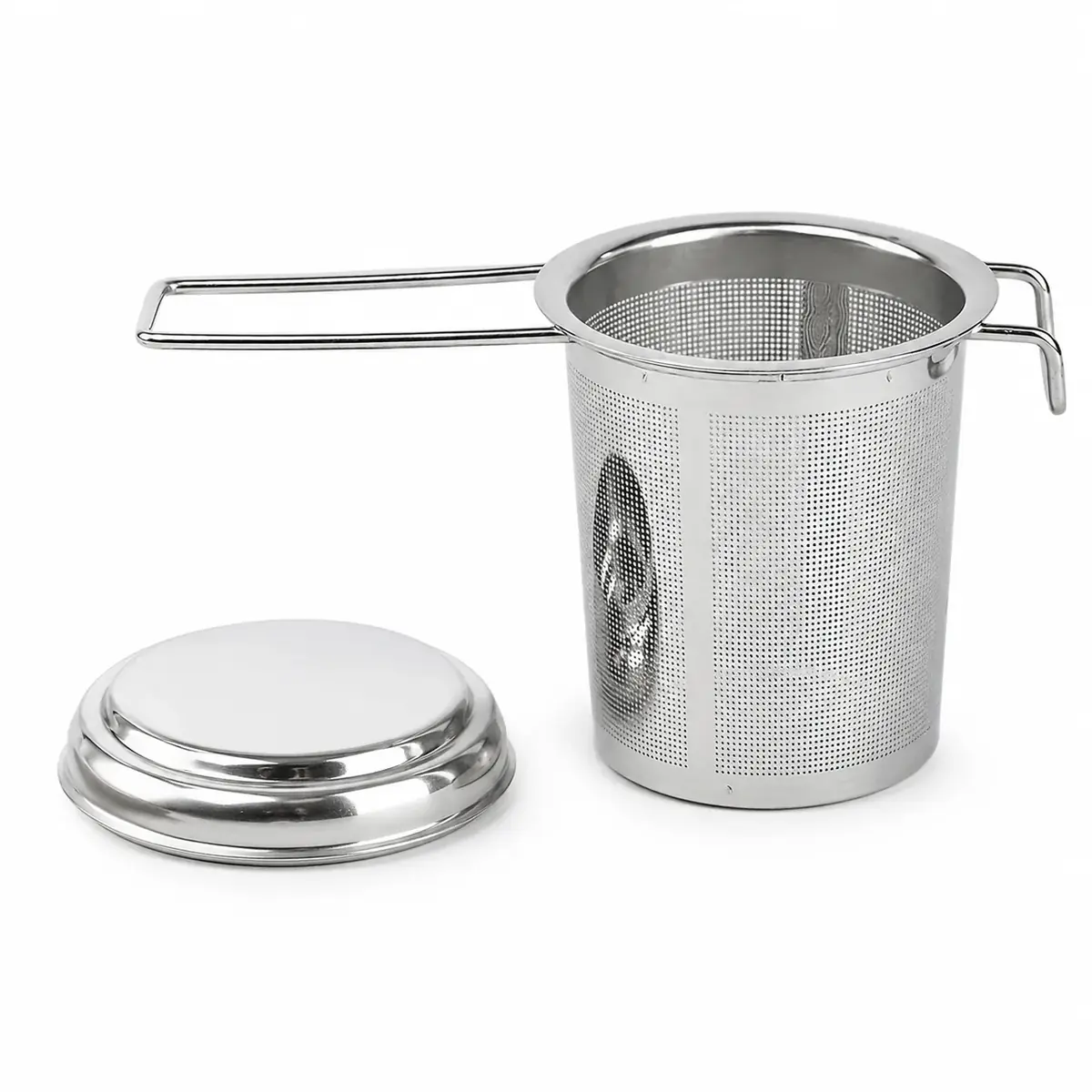
The perforations cover the lower two thirds of the basket, which is the part actually sitting in the water. That placement matters as much as the hole size: it keeps the flow where the liquid is and leaves the upper wall solid, so leaves that swell above the waterline stay put instead of riding over the rim. Buyers who brew rooibos and herbal blends are the ones who notice first, because those are the two that defeat a coarse strainer.
A basket wide enough to matter
7 cm deep, 4.8 cm (1.89 in) across the base, 6.5 cm across the top — a generous scoop with room left to expand.
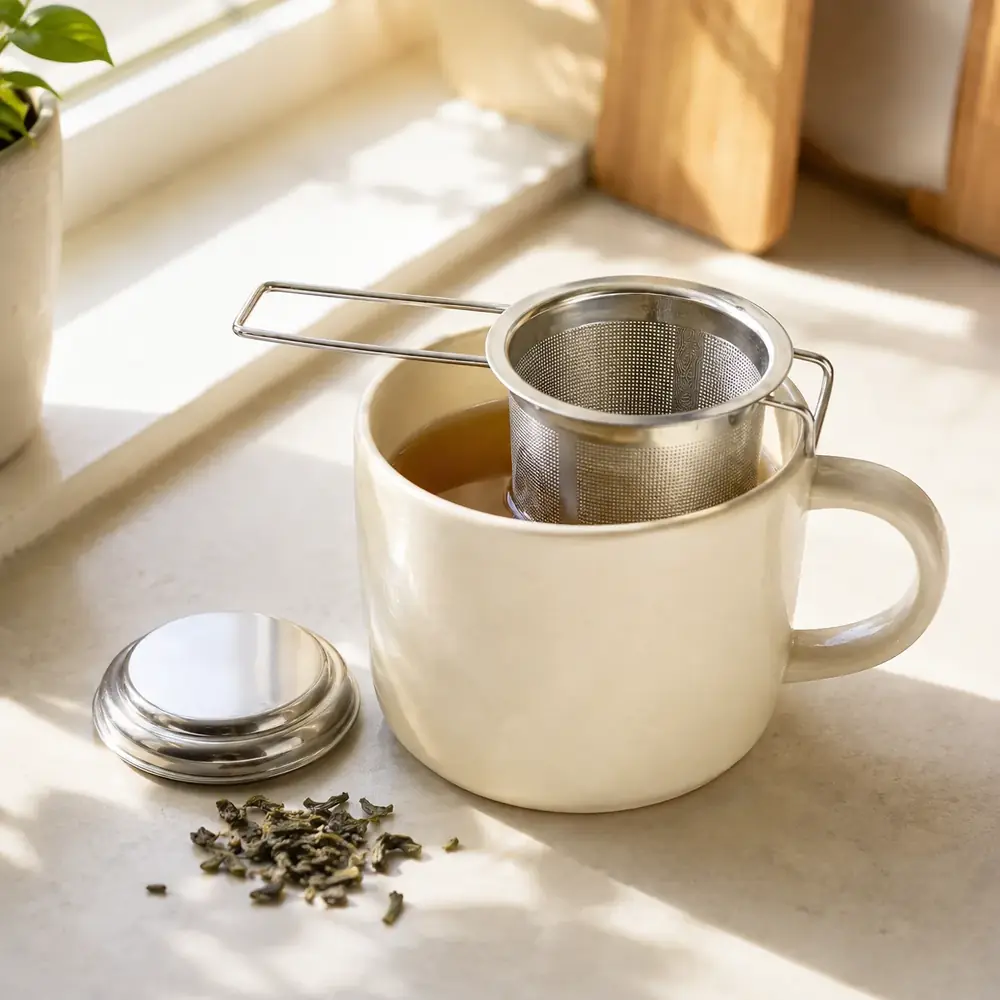
The taper is deliberate. A wider mouth than base means the leaf bed loosens as it swells upward rather than jamming, and it makes the basket easier to empty and rinse. It sits on the rim of a standard mug on two asymmetric handles — one long flat arm, one short hook — which is what lets it balance on wide and narrow rims alike instead of needing a particular cup.
A lid that becomes a tray
Domed lid on top while you steep, flipped over underneath when you lift the basket out.
Covering the cup while tea steeps keeps the temperature up and the aroma in — that part is ordinary. What is not ordinary is that the same lid, turned over, has a raised rim deep enough to catch what drains off a wet basket. It is the detail that comes up again and again in buyer feedback, usually phrased as some version of “so it doesn’t drip”. One less saucer in the sink.
What each size of loose leaf tea infuser actually holds
Here is the capacity of each format, what it comes to in standard 8 fl oz (237 ml) cups, and its size, so you can match the format to how many cups you pour.
| Format | Stated capacity | Cups of 8 fl oz / size |
|---|---|---|
| Infuser basket | Fits the mug you own | 7 cm tall · 4.8 cm base · 6.5 cm rim |
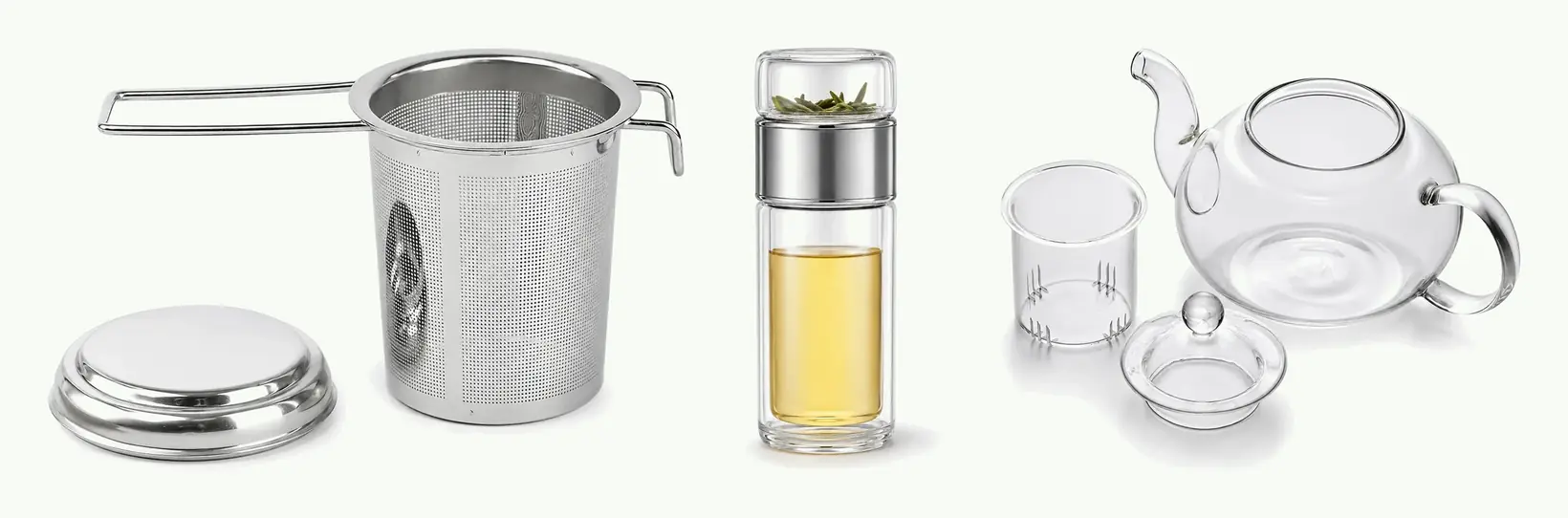
| Infuser bottle | 420 ml (14 fl oz) | about 1.8 cups · 218 × 70 mm (2.76 in) |
| Glass teapot, small | 600 ml (20 fl oz) | about 2.5 cups · 19.9 × 12.5 cm (4.92 in), 9.5 cm (3.74 in) base |
| Glass teapot, large | 1000 ml | about 4.2 cups |
Tea is not a niche habit in the US
servings of tea consumed in the United States in 2023
— Tea Association of the U.S.A., Tea Fact Sheet, 2024
Americans drinking tea on any given day
— Tea Association of the U.S.A., Tea Fact Sheet, 2024
projected annual growth for leaf tea in North America through 2031
— Mordor Intelligence, North America Tea Market, 2025
Loose leaf tea infusers: basket, ball, bottle or teapot
| Format | Room for the leaf | Best for |
|---|---|---|
| Infuser basket | Wide, tapered, 7 cm deep | One mug at a time, any tea, including rooibos and broken grades |
| Infuser ball | A pinched sphere, roughly a teaspoon | Small leaf that does not expand much |
| Infuser bottle | Separate upper chamber, 420 ml below | Carrying brewed tea without the leaves stewing in it |
| Glass teapot | Full-height glass insert, 600 or 1000 ml | Serving two to five cups, and watching the leaves open |
The direction of travel is towards whole leaf: leaf tea in North America is projected to grow 5.85% a year through 2031 (Mordor Intelligence, North America Tea Market, 2025), and whole leaf is precisely the format that needs room to expand.
“I stopped recommending balls to anyone brewing whole leaf. Measure the dry leaf, then measure it wet — the volume roughly triples on a decent oolong. If your infuser cannot hold three times what you put in it, you are only brewing the outside of the leaf.”— Elena Marsh, founder of Teabrim
Choosing your loose leaf tea infuser
Which format should you buy?
If you brew one cup at a time, at a desk or a kitchen counter, the basket is the answer and the cheapest way in. It sits on the mug you already own, handles any grade of leaf, and the flipped lid means you are not hunting for somewhere to park it. It is the format that suits the widest range of teas because it is the one with the most room.
If you leave the house with your tea, the bottle changes the problem rather than solving it with a smaller basket. Leaves sit in the sealed upper chamber above a steel collar; you turn the bottle over to brew, and back to drink. The 420 ml lower chamber is what you actually consume, roughly a cup and three quarters, and the double glass wall means the outside stays comfortable in the hand.
If you pour for more than yourself, go to the teapot. The removable glass insert runs most of the height of the pot, so the leaf bed is deep and the water works through all of it, and borosilicate glass lets you see when the brew is where you want it — which is why people reach for glass here. The 600 ml serves two to three cups, the 1000 ml four to five.
A last practical note on grade. If most of what you drink is rooibos, a herbal blend, or a broken-grade black tea, mesh fineness matters more to you than capacity does, and every format here uses the fine mesh rather than a coarse strainer weave. If you drink large twisted oolongs and whole-leaf whites, capacity is your constraint instead, and the basket or the teapot insert will serve you better than anything you close around the leaf.
Specifications
| Material | Stainless steel basket and lid; borosilicate glass on teapots and bottles |
| Basket size | 7 cm tall, 4.8 cm base, 6.5 cm rim, 43 g (1.5 oz) |
| Handles | Two, asymmetric — one 4 cm (1.57 in) flat arm, one 1.5 cm (0.59 in) hook |
| Mesh | Fine perforation over the lower two thirds |
| Bottle | 420 ml, 218 × 70 mm, double-wall, four collar finishes |
| Teapots | 600 ml (19.9 × 12.5 cm) and 1000 ml, removable glass insert |
| Care | Rinse under running water; the mesh clears with a soft brush |
Water, storage and getting more from the same leaf
Two things change a cup as much as the infuser does, and both are free.
Water temperature. Green and white teas are damaged by water straight off the boil — it scalds the leaf and pulls bitterness forward before the sweetness has come out. Take the kettle off and wait a minute or two, or pour a splash of cold in first. Black teas, rooibos and most herbals want water at full boil and are unbothered by it. Oolong sits in between. If you only change one habit, change this one.
Storage. Tea loses aroma to air, light and warmth, in that order. An opaque tin with a tight lid in a cupboard beats a beautiful glass jar on a sunny shelf, every time. Keep it away from the spice rack and the coffee too, because tea takes on neighbouring smells readily.
Second steeps. This is where a wide basket pays for itself twice. Whole-leaf oolong, white and pu-erh will give a second and often a third infusion, and the second is frequently the best one — the leaf has fully opened by then. Add thirty seconds to the steep and pour again. A leaf compressed in a ball never opens enough to make this worth trying, which is why people who use balls tend to believe multiple steeps are a myth.
How much leaf. A level teaspoon per 8 fl oz cup is the standard start. Large twisted oolongs weigh less for their volume, so go to one and a half. Then adjust by taste rather than by rule, because leaf grade varies far more than any chart admits.
Cold brew. The same leaf in cold water in the fridge for six to twelve hours gives a sweeter, far less astringent drink, because the compounds that carry bitterness need heat to extract. Use half again as much leaf, leave the basket in the jug overnight, and lift it out in the morning.
Rated 4.9 / 5 across 1,558 verified buyers
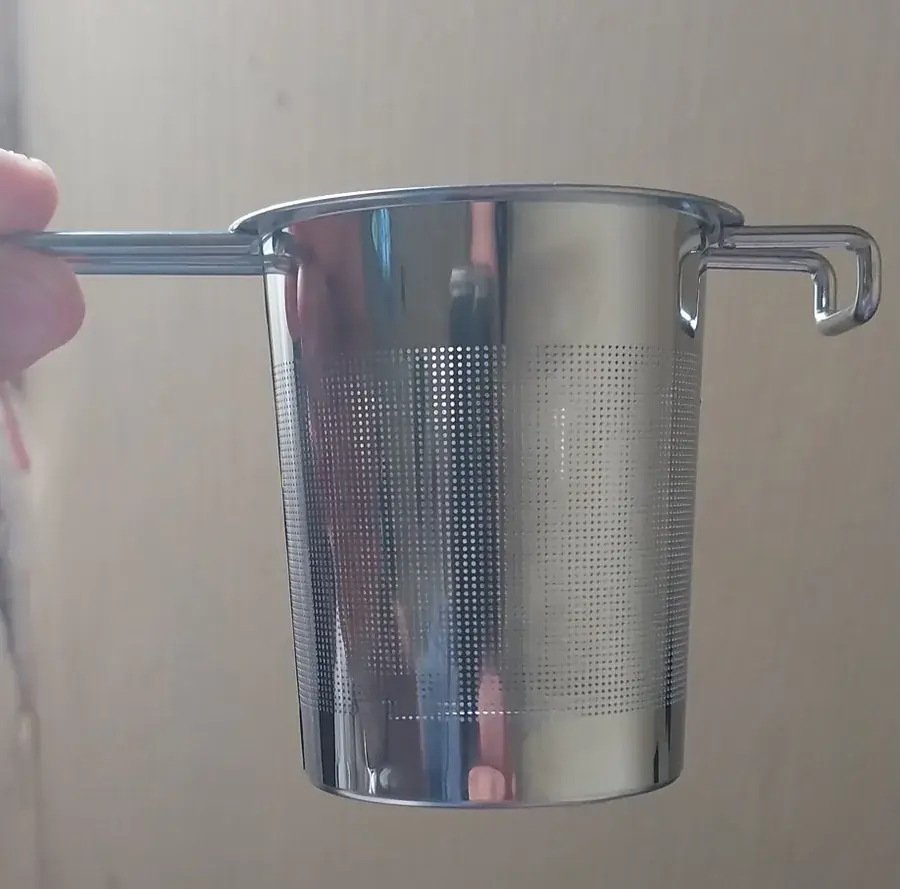
It's smaller than I imagined, but it looks of excellent quality, perfect for use with tea, coffee, or medicinal herbs.
— R***a, verified buyer
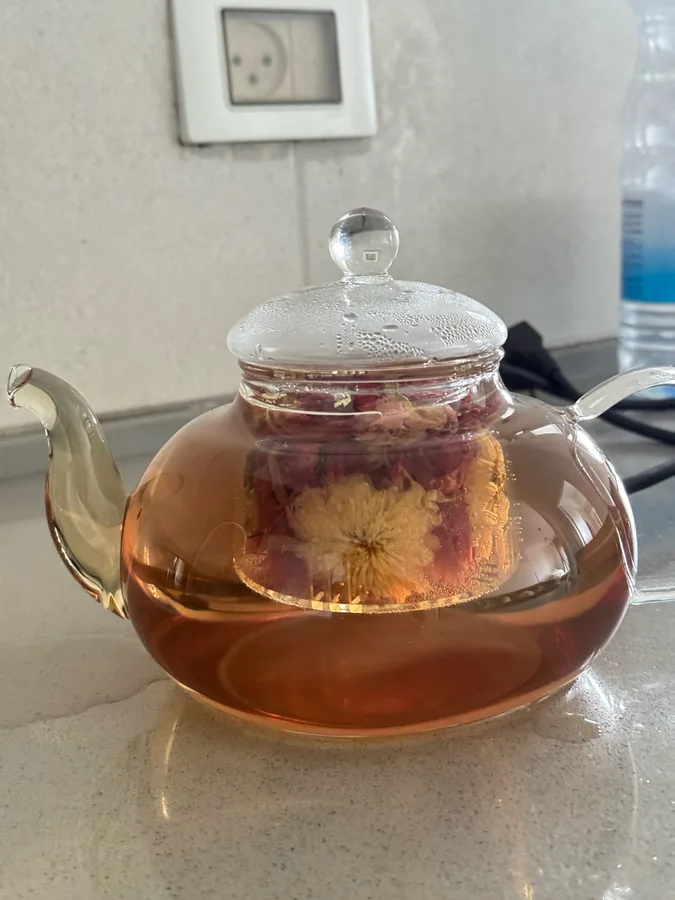
Love it! Perfect price=quality ratio. Thank you ❤️ 🔥
— M***a, verified buyer
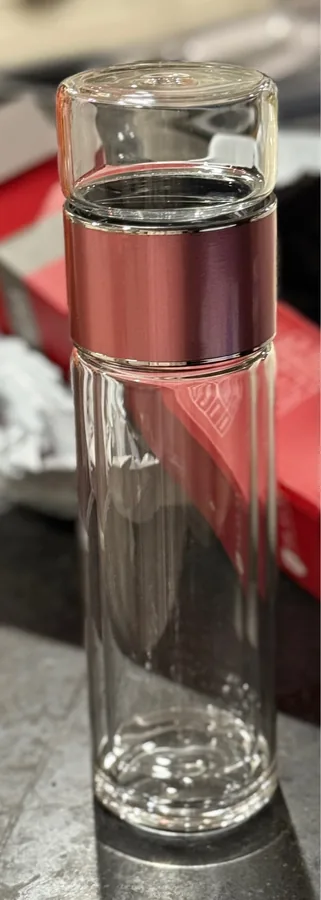
This just arrived exactly as described. Gift – worthy. Tea leaves go in top. Turn it upside down to let it steep. Turn it right side up and it’s ready to go. Great idea. Great product. Great quality. Very well packaged.
— U***r, verified buyer
Questions people ask before buying a loose leaf tea infuser
What is the difference between a tea strainer and a tea infuser?
An infuser holds the leaves while they brew — it sits in the water. A strainer catches leaves after brewing, as you pour, and never goes in the pot. With an infuser you lift the leaves out when the tea is ready; with a strainer the tea passes through it on the way to the cup. A basket like this one is an infuser, and it is also fine enough to do a strainer’s job if you pour through it.
Do you leave the tea infuser in the cup?
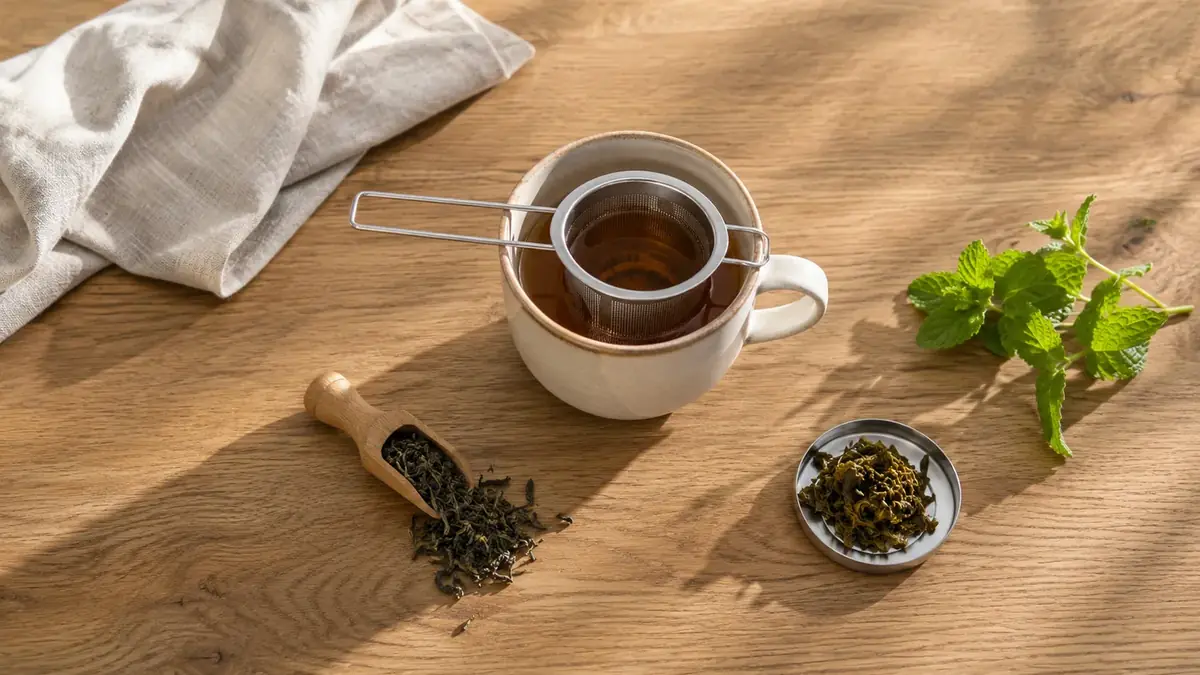
No — lift it out when the tea tastes right, usually somewhere between two and five minutes depending on the leaf. Leaving it in keeps extracting tannins and the cup turns bitter and astringent. That is the practical advantage of a basket with handles: you can pull it the moment the brew is where you want it, and set it on the upturned lid.
How much loose leaf tea should I use per cup?
A level teaspoon of dry leaf per 8 fl oz cup is the usual starting point, and about one and a half for large twisted leaves like oolong, which weigh less for their volume. Adjust from there by taste rather than by rule. The basket holds well over that, deliberately, because the leaf needs room to expand once it is wet.
How long should loose leaf tea steep?
Green tea is usually two to three minutes, black three to five, oolong three to five, herbal and rooibos five or more. Water temperature matters as much as time — greens go bitter in water straight off the boil. Steep by taste and pull the basket early if you are unsure; you can always give it another minute, but you cannot take bitterness back out.
Is a silicone or a stainless steel tea infuser better?
Steel and silicone differ in three ways that matter. Steel does not hold odor, so a smoky lapsang does not follow you into the next cup. Steel mesh can be perforated far finer than molded silicone holes, which is what keeps rooibos and broken leaf out of the drink. And steel is unaffected by water off the boil. Silicone is softer to store and often cheaper.
Can you put boiling water in a glass teapot?
Borosilicate glass is made for it — that is the whole reason teapots use it rather than ordinary soda-lime glass. It tolerates sudden temperature change far better. Two sensible habits anyway: pour onto the leaves rather than straight onto cold empty glass, and do not take a pot from the fridge to boiling water. Our teapots are borosilicate.
Will the basket fit my mug?
It rests on the rim rather than inside the cup, on two asymmetric handles — one long flat arm and one short hook — which is what lets it balance across mugs of different widths. The basket itself is 6.5 cm (2.56 in) across the rim and 7 cm (2.76 in) deep, so it needs a mug with an opening wider than about 7 cm, which covers most standard mugs and teacups.
How do you clean a tea infuser?
Tap the spent leaves out while the basket is still warm — they release cleanly in one go — then rinse under running water. If a fine grade has lodged in the perforations, a soft brush clears it in a few seconds. Doing it straight away rather than letting the leaves dry in is the whole trick; dried tannin is what stains mesh over time.
Give the leaves room
Basket, bottle or teapot — the same wide-and-fine idea, in the size that fits how you drink.
Add to cart →